
Pigtails
Showing all 8 results
Product categories
Product Color
Product Length
- 1.2
- 2.5
Showing all 8 results
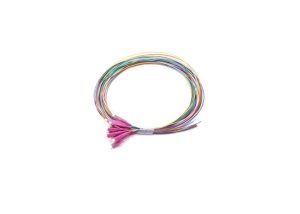
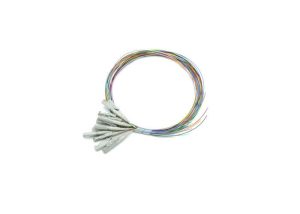
A pigtail, like a patch cord, is a part of passive fiber-optic equipment and is a piece of cable terminated with connectors. The difference between the two is as follows:
patch cord is a piece of copper or optical cable with connectors on both sides. They are used to connect one type of equipment to another and, depending on the type of connections, are equipped with various connectors and adapters;
pigtail (pigtail – “pig’s tail”) – a piece of fiber-optic cable, which is terminated only on one side with an adapter of the appropriate type, depending on the equipment involved.
Pigtails are used as special optical patch cords for terminating optical fiber cables in optical boxes or optical distribution frames. A connector is located at one of the ends of the cable segment, and its free end is connected to the fiber of the trunk cable by welding (welding the cord into various connectors). Mechanical splicing is also permissible due to mechanical splicing.
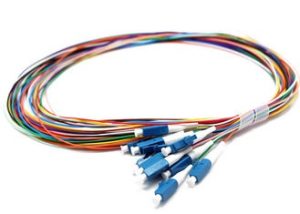
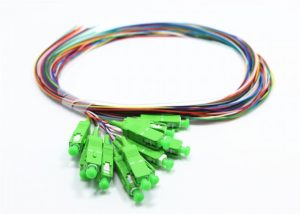
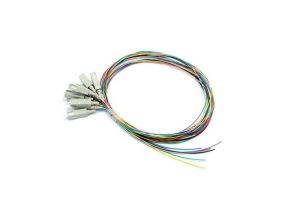
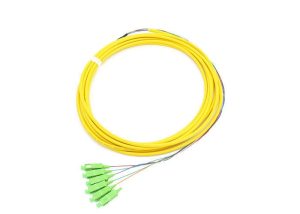
Pigtails are made on the basis of single-mode fiber with various types of connectors (FC, LC, SC, ST) and types of polishing of optical connectors.
When an optical connector is installed at the end of an optical fiber, optical signal loss occurs. Some of the transmitting light is reflected back into the fiber – directly to the light source that created it. This back reflection or return loss can damage the laser light source and disturb the structure of the transmitted signal. Various types of polishes are used to reduce return loss. During the polishing process, the fundamental form factor is the geometry of the end of the ceramic core – ferula (from the English “ferrule” – tip), inside which the fiber is located. There are three types of end geometry – dome, cone and angle. Thanks to the ceramic production of the ferrule, polishing losses are reduced and good wear resistance is maintained.
There are four types of physical contact – polishing:
PC (Physically Contact – physical contact) – polishing with a slight curvature to provide an air gap between the ends of the connectors. When making contact, the fiber connectors touch only in the center – in the core. Initially, this type of polishing used a flat connector tip. But due to the fact that the perfectly flat end did not completely prevent the formation of air gaps, it was replaced with a more rounded one. PC return loss is -30 dB. It is used in systems operating at short distances and not very demanding applications.
APC (Angled Physically Contact) is a connector with processing, when the end face of the ceramic core of the optical connector is made with an angle of 8 degrees. This surface polishing provides the best results, since almost all of the reflected signal due to this angle immediately leaves the fiber, thereby reducing return loss. It is in demand in cable TV networks and high-speed applications, where high requirements are imposed on the quality of the transmitted signal – broadcasting video and voice data.
SPC (Super Physically Contact) – polishing is carried out on a special automatic machine. This type of polishing also provides for the use of connectors with a rounded ferrule. The return loss does not exceed 45dB.
UPC (Ultra Physically Contact) is an almost flat connector manufactured using high-precision surface treatment with an automatic polishing machine. This takes into account the rounding radius of the connector. The return loss index does not exceed 50 dB. Due to its excellent performance (compared to PC and SPC polishes) it is successfully used in high-speed optical networks.
The most popular types of optical connector polishing are UPC and APC. It is unacceptable to connect connectors of these types to each other – damage to both the connectors themselves and a multiple increase in attenuation and reflection is possible.
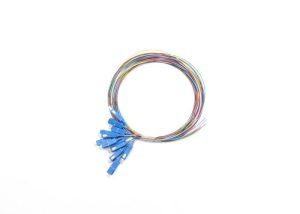
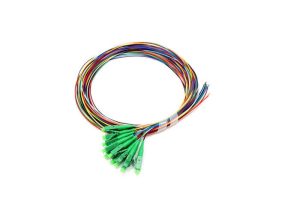
PC, SPC and UPC polishes are compatible with each other, as there is no angle polish like in APC. The method of polishing the end of the connector is indicated by color coding: blue – UPC polishing type, green – APC polishing type.
Pigtails have a diameter of 50 to 120 microns. For mounting in optical boxes, pigtails with a fiber in a dense buffer or free sheath with a diameter of 0.9 mm are used, and for the outer output – with an additional protective sheath with a diameter of 2 or 3 mm.
Important characteristics of pigtails are the number of connection cycles the connectors are designed for, as well as the temperature range in which the pigtail can operate. It ranges from -40 to +75 C. In our online store, pigtails with the most advanced polishing of APC and UPC optical connectors are presented with a length of 1.5 m.